
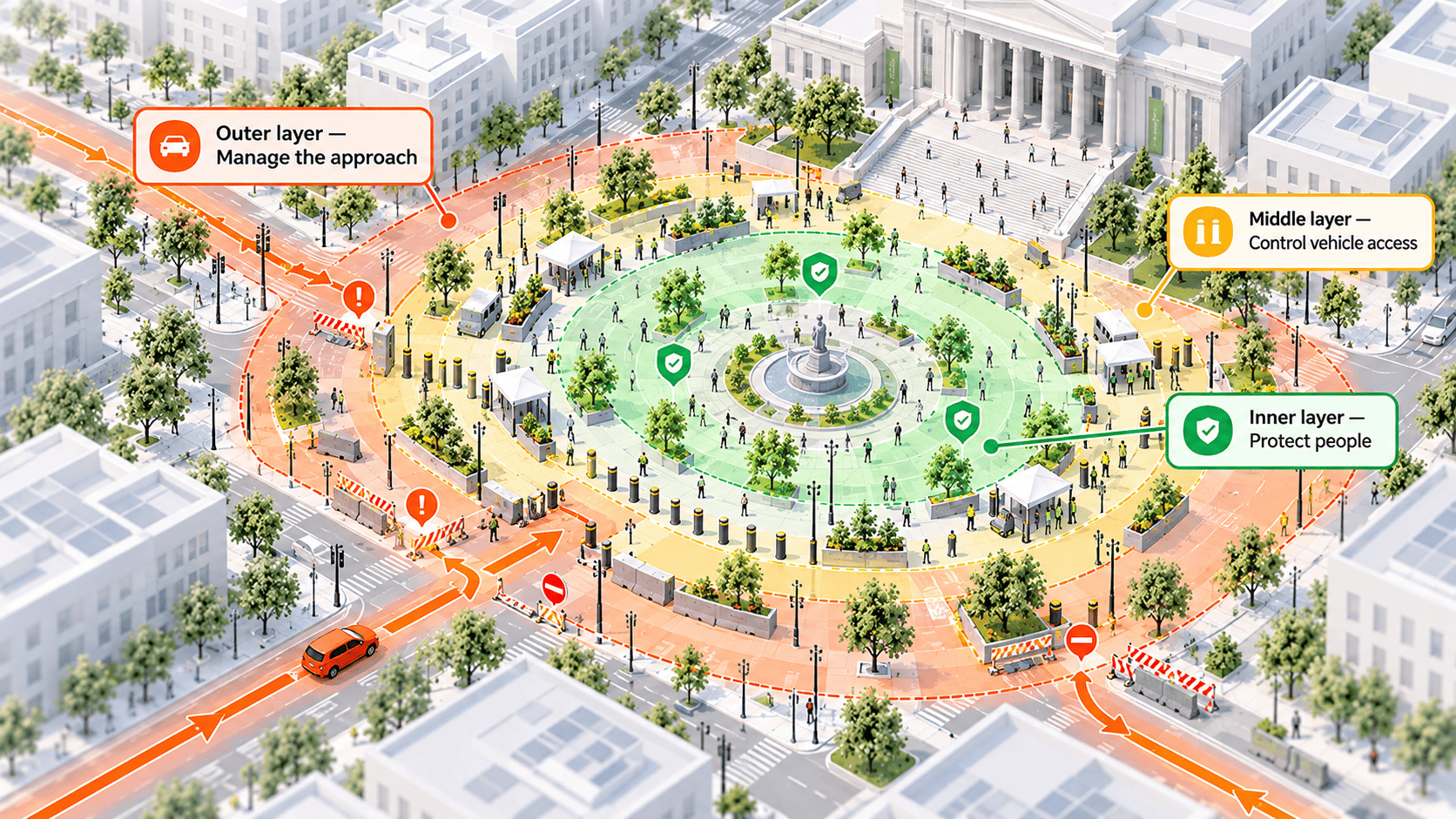
One of the easiest ways to understand Hostile Vehicle Mitigation (HVM) is as a series of protective layers.
The “onion-ring” concept is a useful visual model: instead of relying on a single defensive line, several measures work together between the possible vehicle approach and the people being protected.
CISA similarly recommends a layered approach to security, combining planning, traffic and crowd management, staff awareness and appropriately installed active or passive barriers.
Outer layer — Manage the approach
Road closures, traffic diversion, restricted routes, remote parking and road geometry can reduce vehicle access and achievable speed.
Middle layer — Control vehicle access
Closer to the protected area, appropriate impact-rated barriers, checkpoints or controlled access points can restrict vehicles that still need to approach the site.
Where movable or active barriers are used, operational procedures become particularly important.
Inner layer — Protect people
Pedestrian-only zones, protected queues and sufficient standoff provide another layer between vehicles and crowds.
If one layer is bypassed or fails, another should remain between the hostile vehicle and the people or assets being protected.
The bigger idea
Effective Hostile Vehicle Mitigation is not simply about installing stronger barriers.
It is about understanding how a hostile vehicle could reach a crowded place, reducing what that vehicle can achieve, and positioning appropriate protection where it matters most.
Digital tools help turn that reasoning into a security plan that can be understood, discussed and implemented in the real world.
Request a demo