
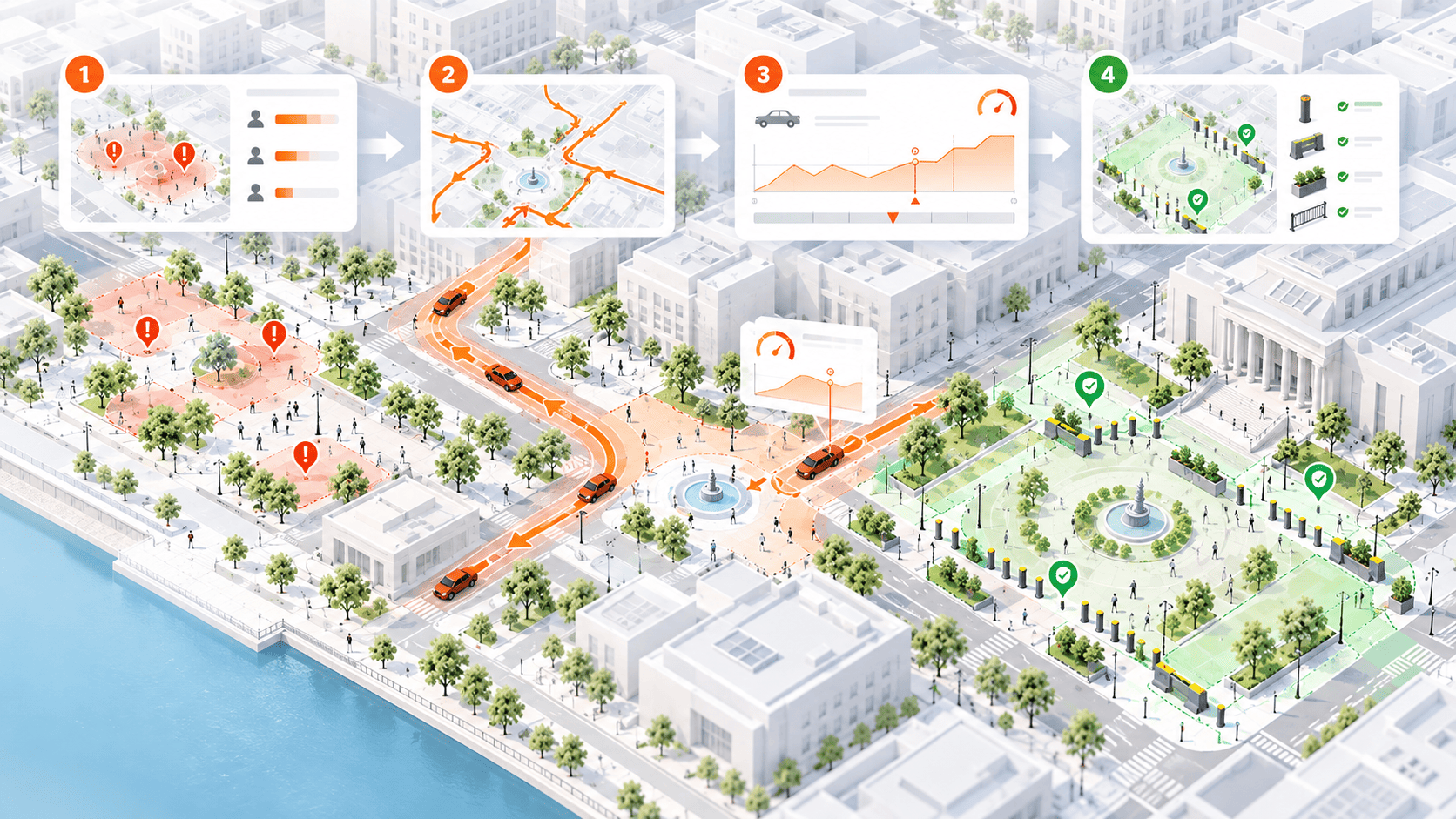
Effective Hostile Vehicle Mitigation starts with a simple question:
Good HVM therefore begins with the site and the potential attack route—not with a barrier catalogue.
NPSA describes HVM as a risk-based discipline informed by the threat, its potential consequences, the vulnerability of the location and the needs of the organisation being protected. [3]
Security teams need to consider possible vehicle approaches, the type and mass of vehicle, achievable speed, road geometry, pedestrian concentrations and the possible consequences of an impact.
A useful way of thinking about the process is:
Vehicle speed is particularly important
A truck approaching along a long, straight road creates a very different threat from the same vehicle navigating a tight corner at low speed.
NPSA considers a Vehicle Dynamics Assessment (VDA) a vital step in HVM design because it helps quantify vehicle types, approach routes and potential speeds. [4]
Good HVM is not only about stopping a vehicle
Good HVM therefore does not only ask how to stop a hostile vehicle. It also considers how to:
- restrict its approach;
- reduce achievable speed;
- alter its trajectory;
- increase standoff;
- separate vehicles from pedestrians.
Sometimes, changing what a vehicle can physically do before it reaches the protected area is as important as the final barrier itself.
Request a demo