
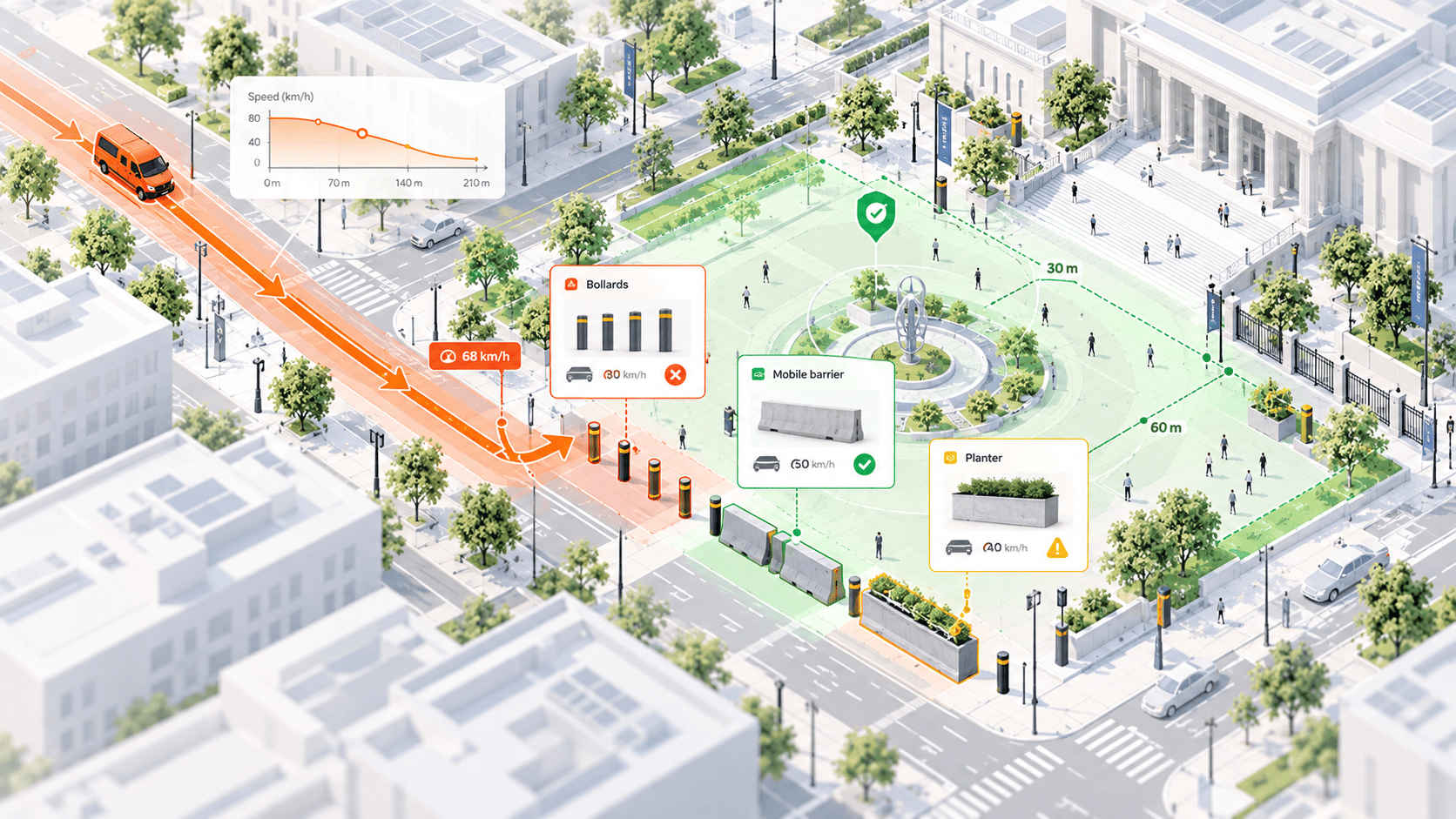
Barrier selection should be based on recognised performance standards.
Today, ISO 22343-1:2023 is a central international reference for vehicle security barriers. It defines impact-performance requirements, vehicle-impact test methods and performance ratings.
ISO 22343-2:2023 complements it with guidance on the selection, installation and use of vehicle security barriers.
In the United States, ASTM F2656/F2656M-23 remains an active standard for crash testing vehicle security barriers. Importantly, ASTM itself warns that a penetration rating does not mean that a barrier will perform identically under every site condition or threat scenario. [7]
Older standards such as PAS 68 and IWA 14-1 will still appear on products previously tested under those schemes. However, they should now be regarded as legacy standards. NPSA states that ISO 22343-1 supersedes PAS 68 and IWA 14-1, which are withdrawn, while previously tested products may still retain valid legacy ratings. [8]
The practical lesson is important:
Its suitability still depends on factors such as vehicle type and mass, approach speed, impact conditions, available space, foundations, required standoff and operational access.
The bigger idea
Effective Hostile Vehicle Mitigation is not simply about installing stronger barriers.
It is about understanding how a hostile vehicle could reach a crowded place, reducing what that vehicle can achieve, and positioning appropriate protection where it matters most.
Digital tools help turn that reasoning into a security plan that can be understood, discussed and implemented in the real world.
Request a demo